
“The doctor said I have piriformis syndrome.” This phrase often leaves patients confused, because pain radiating down the leg makes many people assume the problem is in the spine. But in reality, piriformis syndrome has a different origin.
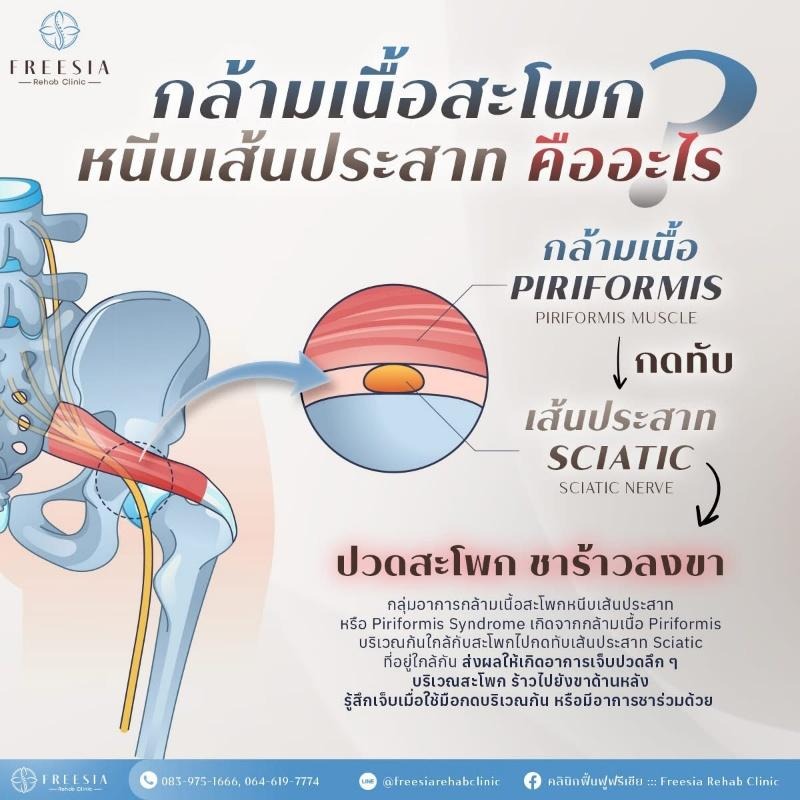
What Is Piriformis Syndrome?
Piriformis syndrome is a condition in which the piriformis muscle, located deep in the buttock, becomes inflamed or goes into spasm, pressing on or irritating the nearby sciatic nerve. This causes deep pain in the buttock that may radiate down the thigh, calf, or foot — similar to the symptoms of a herniated disc compressing a nerve, but with a completely different cause and treatment.
The piriformis muscle’s job is to rotate the leg outward (external rotation), and it plays a crucial role in balance and walking. When this muscle malfunctions, it can affect movement in many aspects of daily life.
Symptoms Commonly Seen in Patients
- Deep pain in the buttock, usually on one side, tender to the touch
- Symptoms worse with prolonged sitting, especially on hard surfaces or during long drives
- Symptoms improve when standing up or walking
- In some cases, pain radiating down the leg — burning, electric-shock sensations, or numbness along a line
- Symptoms often worsen when climbing stairs, squatting, or sitting cross-legged
Who Is at Risk of Piriformis Syndrome?
Piriformis syndrome is common in several groups: runners and athletes who put heavy loads on their legs; people who sit at work for long periods without moving; those with weak gluteal muscles or imbalances in the muscles around the hip; and people who have previously injured the buttock or hip area. In addition, women are at higher risk than men due to differences in pelvic structure.
Why Is Diagnosis So Important?
Because the symptoms of piriformis syndrome resemble many other conditions — such as a herniated disc pressing on a nerve, sciatic neuritis, or hip arthritis — diagnosis relies on a thorough physical examination by a physician, along with specific clinical tests such as the FAIR test (Flexion, Adduction, Internal Rotation), which helps identify the true cause.
Treatment and Self-Care
Current, evidence-based treatment guidelines combine several components:
- Exercise therapy: stretching the piriformis and the muscles around the hip, together with strengthening the gluteus medius, to reduce pressure on the nerve.
- Wave- and instrument-based therapy: ultrasound therapy, shockwave therapy, or TENS can help reduce inflammation and pain.
- Activity modification: avoid sitting still for longer than 45–60 minutes, avoid sitting cross-legged or in positions that trigger symptoms, and adjust the firmness of your seat cushion.
- Physician-delivered treatment: Western acupuncture (dry needling) to release the muscle, or injections. In severe cases that don’t respond to initial treatment, the doctor may consider injecting medication into the muscle area under ultrasound guidance.
How to Live So the Symptoms Don’t Come Back?
The most important thing is to continue treatment until the muscles around the hip are strong and flexible enough, while adjusting your daily habits. Appropriate exercise — such as swimming, cycling, or hip-focused yoga — does a good job of reducing the chance of recurrence. You should also avoid running on slopes or uneven terrain while you still have symptoms.
If you still have buttock pain radiating down the leg, or you’re not sure what’s causing it, you can consult a rehabilitation medicine specialist directly at Freesia Rehab Clinic, Rama 3. An accurate diagnosis from the very start is the first step toward getting back to living life to the fullest.
References
- Boyajian-O’Neill LA, et al. Diagnosis and management of piriformis syndrome: an osteopathic approach. J Am Osteopath Assoc. 2008;108(11):657-64.
- Hopayian K, Danielyan A. Four symptoms define the piriformis syndrome: an updated systematic review of its clinical features. Eur J Orthop Surg Traumatol. 2018;28(2):155-164.
- Tonley JC, et al. Treatment of an individual with piriformis syndrome focusing on hip muscle strengthening and movement reeducation. J Orthop Sports Phys Ther. 2010;40(2):103-11.