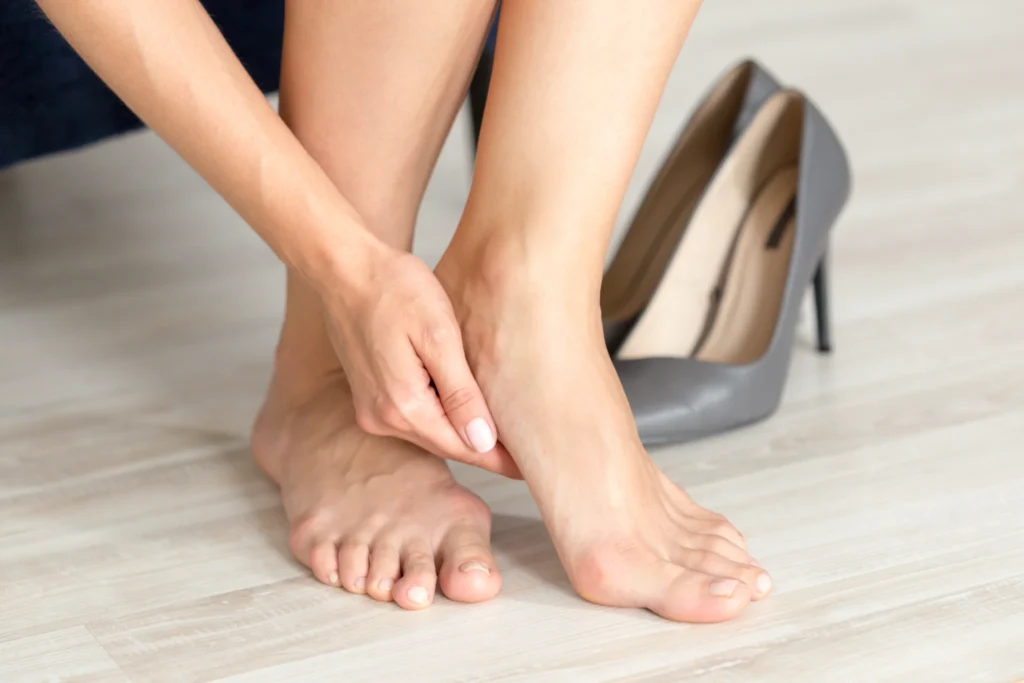
Think about the morning when you get out of bed and your first step onto the floor sends a jolt of pain through your foot.
Many people brush it off as just “still waking up.” But if this happens every day — especially at the heel — there’s a good chance you’re dealing with plantar fasciitis, and the shoes you’re wearing may be part of the problem.
What Is Plantar Fasciitis, and Why Does the First Step Hurt the Most?
Plantar fasciitis is the inflammation of the plantar fascia — the band of fibrous tissue that runs from the heel to the base of the toes, supporting the arch of the foot and distributing your weight with every step.
While we sleep, this fascia tightens and shortens. When you stand up and your weight presses down, it is suddenly stretched out. That’s what causes the intense pain in the first step — which often eases after walking for a while, but returns after sitting or resting for a long time. Research in Foot & Ankle International shows that plantar fasciitis is the leading cause of heel pain in adults, and it is directly linked to unbalanced weight-bearing and footwear that doesn’t provide enough shock absorption.¹
Which Shoes “Help” and Which Make Things “Worse”
Here’s what many patients don’t realize: a shoe that looks pretty or feels soft is not necessarily good for plantar fasciitis.
1. A Moderate Heel Drop (8–12 mm)
Slightly raising the heel reduces the tension on the plantar fascia and the Achilles tendon, so the fascia doesn’t have to work as hard with each step. Research confirms that appropriate heel cushioning significantly reduces heel pain.²
2. Shock-Absorbing Heel Materials
Look for foam, gel, or EVA cushioning specifically in the heel area — not just a uniformly soft outsole.
3. A Firm Midsole Structure
The midsole must support your weight without twisting or bending easily. Test it by pressing down on the middle of the sole — if it collapses more than it should, it isn’t firm enough.
4. A Wide Enough Toe Box
Shoes that squeeze or press on the toes keep the plantar fascia constantly stretched, adding inflammation without you noticing.
Shoe Types to Avoid Outright:
High heels over 5 centimeters, thin flat sandals with no structure, and walking barefoot on tile or wooden floors — a hard surface with no shock absorption is plantar fasciitis’s worst enemy.
Plantar Fasciitis Is Treatable — But It Starts With the Right Diagnosis
Many people buy new shoes on their own hoping the pain will improve. Some do get better, but for many it doesn’t work, because the underlying problem may be more complex — such as unusually tight calf muscles, body weight placing more load on the fascia than it can handle, or foot alignment issues that need to be addressed at the same time.
Effective plantar fasciitis treatment usually requires an assessment to identify the root cause before planning targeted care — not just temporary pain management.
Your first step in the morning shouldn’t hurt. Come consult a rehabilitation-medicine physician at Freesia Rehab Clinic for an assessment, an analysis of the true cause, and comprehensive guidance on caring for plantar fasciitis — from choosing the right shoes and muscle rehabilitation to a treatment plan tailored specifically to you. Because pain with every step is not something you have to live with.
References
1. Wearing, S.C. et al. (2006). The pathomechanics of plantar fasciitis. Foot & Ankle International, 27(12), 1089–1097.
2. Landorf, K.B. & Menz, H.B. (2008). Plantar heel pain and fasciitis. BMJ Clinical Evidence.
3. Lareau, C.R. & Sawyer, G.A. (2012). Plantar and medial heel pain: diagnosis and management. Journal of the American Academy of Orthopaedic Surgeons, 20(8), 506–516.