

I get asked this question a lot when examining patients. To answer honestly: office syndrome can improve a great deal — but if the behaviors that caused the symptoms don’t change, the odds of the symptoms coming back are very high too. So a “complete cure,” in the true sense of “recovering and staying recovered,” requires treatment and behavior change together.
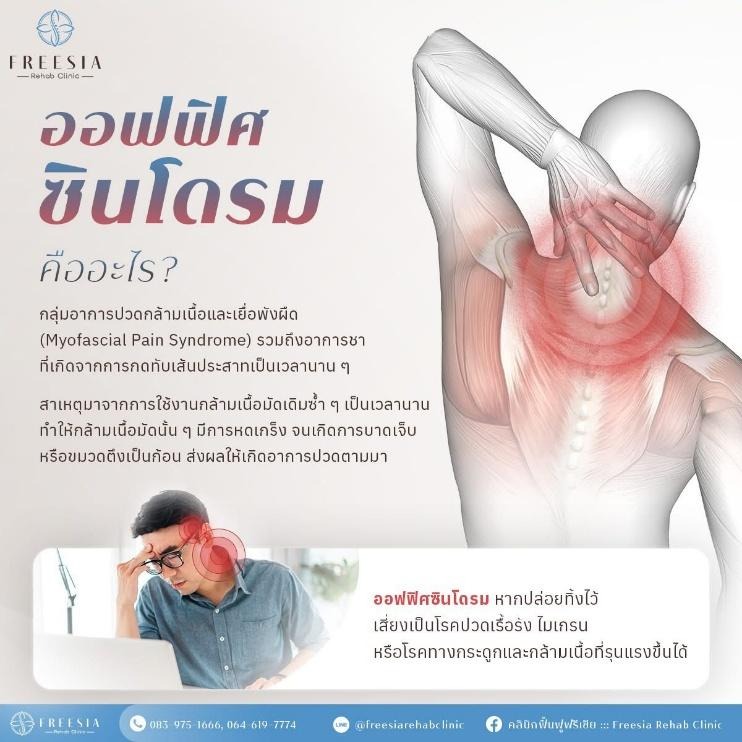
What Causes Office Syndrome?
Office syndrome isn’t a single disease — it’s a group of symptoms called myofascial pain syndrome, caused by repeatedly using muscles in poor positions over a long time until painful trigger points develop in the muscle, along with muscle tightness and chronic inflammation. It can occur in any muscle group in the body, but the most common sites are the shoulders, neck, shoulder blades, and lower back.
Treatment That Works
Evidence-based treatment for this condition combines several components:
- Medical treatment and machine-based physical therapy — including dry needling, shockwave therapy, high-power laser therapy, therapeutic ultrasound, and various forms of electrical stimulation — to reduce trigger points and muscle inflammation.
- Exercise and strengthening: stretching plus strengthening of the core, neck, and shoulder blades to take the load off overworked muscles.
- Ergonomic adjustments: desk height, chair, monitor position, and keyboard placement all directly affect posture and the chance of symptoms recurring.
- Changing the habits that repeatedly overload the same muscles.
Which Behavior Changes Actually Help?
- Take a break and move around every 45–60 minutes; avoid sitting still for more than an hour and a half.
- Check your sitting posture: back straight, shoulders relaxed, elbows level with the desk.
- Exercise regularly — it doesn’t have to be intense, but it must be consistent.
- Protect your sleep quality, because muscles repair themselves best during sleep.
Why Doesn’t Massage Alone Fix It?
Massage relaxes the muscles temporarily, but if the root cause — your posture and the way you sit at work — isn’t addressed, the muscles will tighten up again before long. That’s why systematic treatment by a specialist physician, combined with behavior change, delivers more lasting results.
If you’re still having symptoms, or you’re unsure what kind of care your condition needs, you can consult a rehabilitation medicine specialist directly at Freesia Rehab Clinic, Rama 3. Getting the right care from the start helps you get back to living freely, the way you’re meant to.
References
• Simons DG, Travell JG, Simons LS. Myofascial Pain and Dysfunction: The Trigger Point Manual. 2nd ed. Williams & Wilkins; 1999.
• Dommerholt J, Huijbregts P. Myofascial Trigger Points: Pathophysiology and Evidence-Informed Diagnosis and Management. Jones & Bartlett; 2011.
• Blangsted AK, et al. Work-related neck-shoulder pain: a review. Occup Environ Med. 2008;65(2):79-87.