
One of the most common questions we hear from athletes and fitness enthusiasts is “Doctor, why does my shoulder sting when I lift my arm to shampoo my hair?” or “Why does it hurt so much when I sleep on my side that I wake up?” These shoulder pain symptoms usually don’t come from ordinary muscle fatigue — they are warning signs from the Rotator Cuff, the group of muscles and tendons surrounding the shoulder joint.
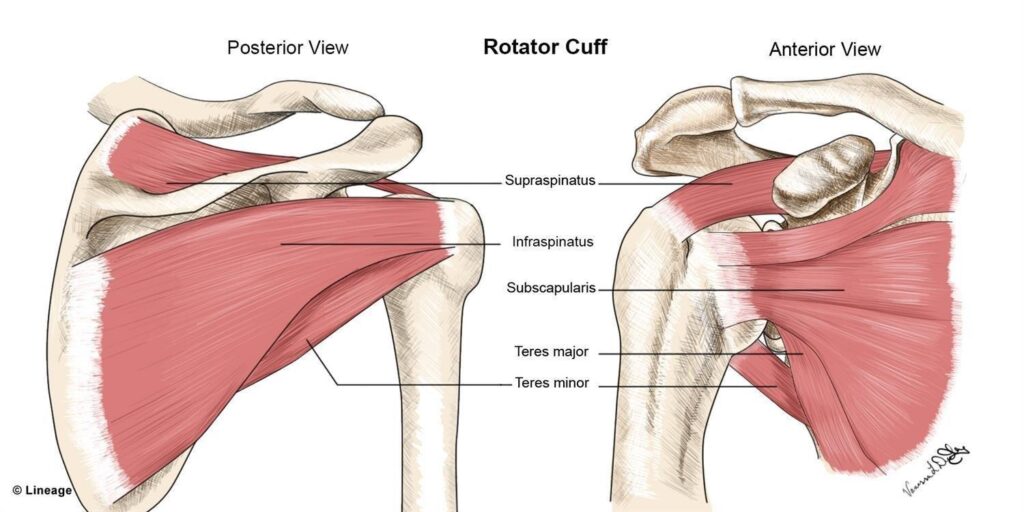
Rotator Cuff: A Small “Engine Kit” That Carries an Enormous Load
Many people assume our shoulders are strong because of the big, visible deltoid muscle. In fact, shoulder stability depends on four small tendons that come together to wrap around the shoulder joint like a “cuff.” This tendon group lets us rotate and lift the arm while keeping the shoulder head securely seated in its socket.
Why Are Athletes at Risk of Rotator Cuff Injuries?
In the world of sports, the shoulder is the most mobile joint — and also the most fragile. Rotator Cuff Syndrome typically affects three main types of sports:
Overhead Sports
Such as badminton, tennis, volleyball, or swimming. Repeatedly swinging the arm at high speed puts continuous stress on the tendons, leading to very small tears (microtears).
Weight Training
Especially bench press or shoulder press with excessive weight, or with poor form. This narrows the space inside the shoulder joint until the tendons get compressed (impingement).
Contact Sports or Accidents
Such as football or basketball, where falls and impacts — or having the arm suddenly yanked — can occur.
Check the Warning Signs: Which Kind of Pain Means “Tendonitis”?
If you have any of these symptoms, we recommend seeing a doctor:
Pain When Raising the Arm
Especially when abducting the arm through the 60–120 degree range.
Pain at Night
This is the classic symptom — pain severe enough that you can’t sleep on that side, or a deep ache inside the shoulder that keeps you awake.
Arm Weakness
A feeling that you’ve lost the strength to reach for something on a high shelf, or that your smash in badminton has simply lost its power.
Clicking or Catching
A sensation that something is grinding or catching inside the shoulder when you move it.
Treatment: “Repair” at the Right Spot, “Recover” at the Right Pace
In rehabilitation medicine, we don’t just focus on painkillers — we focus on “rebalancing” the joint:
Rest and Inflammation Control
For acute pain, rest and cold compresses are still the heroes of the moment. The doctor may use tools such as High Power Laser or ultrasound therapy to stimulate the inflamed tendon to repair itself faster.
Physical Therapy
Once the pain subsides, we begin training the muscles known as scapular stabilizers — the muscles around the shoulder blade. A stable scapula is the strong foundation of the shoulder; if the foundation is poor, the shoulder tendons must overwork and become inflamed again and again.
Injection Therapy (Interventional Rehab)
For chronic inflammation, we can now use ultrasound guidance to inject medication or concentrated platelets (PRP) directly into the tear site — far more precise and safer than blind injections of the past.
Prevent It Before It Breaks: Essentials for Athletes
Warm Up Properly
Don’t step onto the court before your shoulders are warmed up. Light arm circles or dynamic stretching improve blood flow to the tendons.
Train the Small Muscles
Don’t train only the big, visible muscles for looks. Regularly practice internal/external rotation of the shoulder with a resistance band as well.
Listen to Your Body
If you start to feel a sting during training, that is a command to “stop” — not to “push through” until you’re injured.
The most effective treatment for rotator cuff tendinitis is treating it while it is still “inflamed” — not waiting until it has “torn,” because repairing a fully torn tendon is far harder and takes much longer. If the tendon is severely torn, surgery to repair it may be needed to restore good function. If you have shoulder pain that doesn’t improve with rest, come consult a rehabilitation physician at Freesia Rehab Clinic, Rama 3.